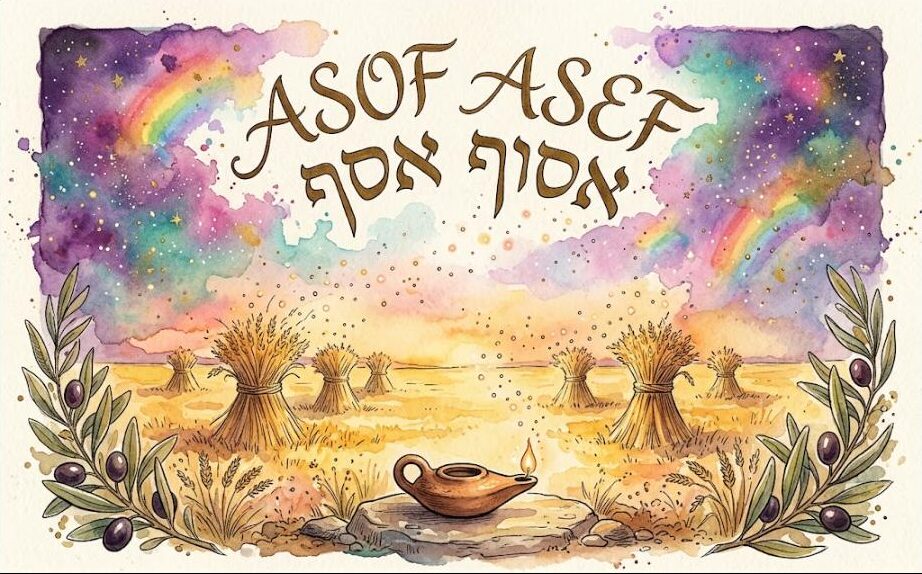
Asof Asef: Harvest, Ruin, and the Lamp That Tells Them Apart
Rachel names her son twice in one breath, and the two verbs point in opposite directions.
אָסַף אֱלֹהִים אֶת חֶרְפָּתִי
God has gathered away my disgrace. Bereishit 30:23
יֹסֵף ה’ לִי בֵּן אַחֵר
May God add to me another son. Bereishit 30:24
The name stands on the second verb, and the first is fused into it. אָסַף, taking away, and יָסַף, adding, one letter apart, both spoken over the same child. The one who adds is named in the same breath as the taking-away.
Gathering at full strength is un-creation
Open the prophet whose own name carries Yosef’s Egyptian one. צְפַנְיָה is built on צפן, to conceal, the same root hidden inside צָפְנַת פַּעְנֵחַ, the name Pharaoh gave the decoder of concealed things.
The prophet of concealment opens his book with Rachel’s verb turned to its full register.
אָסֹף אָסֵף כֹּל מֵעַל פְּנֵי הָאֲדָמָה
I will utterly gather away everything from the face of the earth. Tzefaniah 1:2
Man and beast, the birds of the heavens and the fish of the sea, all swept up in one asaf (1:3). Gathering, at that strength, is the undoing of creation.
One verb for the harvest and for the grave
The Torah already uses this root for death. נֶאֱסַף אֶל עַמָּיו, gathered to his people, is how Avraham dies, how Yaakov dies, how Aharon and Moshe die.
It uses the same root for the harvest. חַג הָאָסִיף, the festival of ingathering, when the grain is taken up from the field.
One verb gathers the crop, gathers the soul, and gathers away the world. Whether asaf is harvest or annihilation depends entirely on what stands ready to receive what has been gathered.
The prophet names the instrument
Between the gathering-away at his opening and the gathering-home at his close, Tzefaniah puts a search, and the search is conducted by candlelight.
אֲחַפֵּשׂ אֶת יְרוּשָׁלַיִם בַּנֵּרוֹת
I will search Jerusalem with lamps. Tzefaniah 1:12
The Gemara hears exactly where that lamp points, running the search-by-lamp through this verse into another (Pesachim 7b-8a).
נֵר ה’ נִשְׁמַת אָדָם
The lamp of God is the soul of man. Mishlei 20:27
The lamp that searches the concealed city is a human soul, lit and carried into the dark. Asaf with no lamp is the sweep, everything gathered away undifferentiated. Asaf by lamplight is the return, the concealed found, recognised, and gathered home.
The gathering was never optional. The only question the prophet leaves open is whether anybody is out searching with a lamp when it arrives.
His book closes on the other end of the same motion.
בְּעֵת קַבְּצִי אֶתְכֶם
At the time I gather you in. Tzefaniah 3:20
The third verb, and the birthstool
A third title names what Yosef does with what was added.
הוּא הַמַּשְׁבִּיר לְכָל עַם הָאָרֶץ
He was the provider to all the people of the land. Bereishit 42:6
Most read it as the supplier of grain and stop. שֶׁבֶר is a breaking, and מַשְׁבֵּר is the birthstool, and the two senses are one skeleton read at two depths. Hoshea sets a son who will not present at the breaking point, עֵת לֹא יַעֲמֹד בְּמִשְׁבַּר בָּנִים (Hoshea 13:13), and Yeshayahu answers in God’s own voice.
הַאֲנִי אַשְׁבִּיר וְלֹא אוֹלִיד
Shall I bring to the birthstool and not deliver? Yeshayahu 66:9
The man who fed a starving world through seven years of famine is named for the stool a woman breaks open on. Yosef is not only distributing grain. He stands at the birthstool of the nations, delivering life through the narrow passage of scarcity, one sack at a time. The famine is the labour. The grain is the delivery.
The verb that gathered him away and the verb that adds resolve into the verb that delivers.
Argued in full in Kol Tehom, free in English and in Hebrew.
Keep reading
- Yosef the redeemer who inherited on a technicality
- Tehom the only man in the Torah blessed with the deep, twice
- With Smells We Smelt Light refining needs fire and a flux, and Havdalah is both
The map shows how all of it connects.

New teachings by email, and a bottle to pick up from us in Petah Tikva. The light of Sinai for your table.