A Genizah Is a Vault, Not a Grave
Everyone assumes a worn sacred text is buried. Put in the ground, like a body, finished. The Hebrew does not say buried.
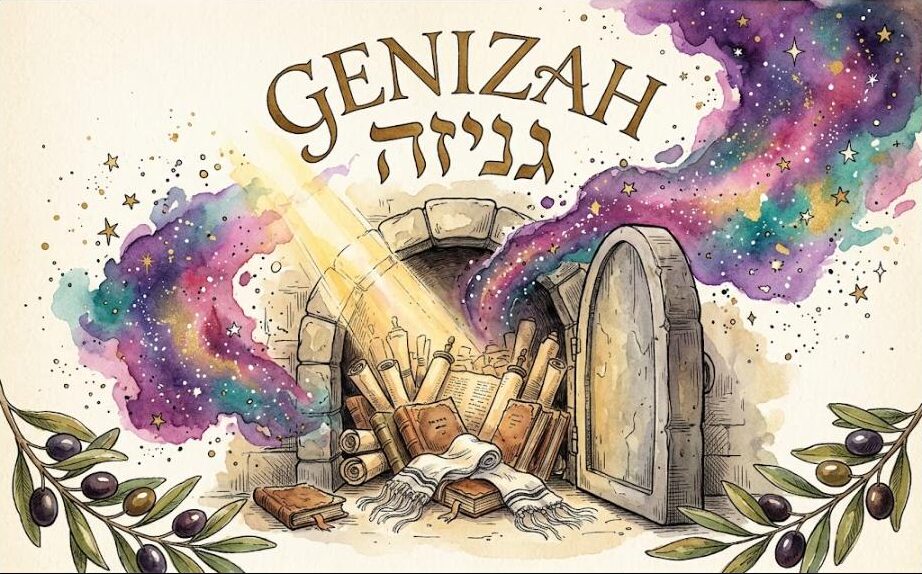
It says נִגְנַז: stored, hidden, treasured away. The root is ג־נ־ז, and it is the same root as גִּנְזֵי הַמֶּלֶךְ, the king’s treasuries (Esther 3:9).
A genizah is a vault.
The Gemara treats it as storage, not disposal
The Gemara asks why a worn Torah scroll is placed inside an earthenware vessel before it goes into the ground, and answers that it is to slow the decay of the writing and preserve it as long as possible (Megillah 26b).
That is the logic of a seed kept in a jar so it does not rot before its season. Nobody packs a corpse to keep it fresh.
The same verb holds the light of the first day
Hear the root in the most exalted place it appears. The light of the first day, the אוֹר that God saw was good, the light by which Adam saw from one end of the world to the other, was not spent. It was hidden away, גָּנוּז, stored for the righteous in the world to come (Chagigah 12a).
That is the Ohr HaGanuz, the treasured light. It is the identical verb.
The worn scroll is nignaz. The light of creation is ganuz. The buried letter and the hidden light share one word because they share one fact: a holy thing is never destroyed. It is only treasured out of sight, waiting for a hand that knows it is still alive.
You are a letter
The Zohar Chadash reads the name Yisrael as an acronym: יֵשׁ שִׁשִּׁים רִבּוּא אוֹתִיּוֹת לַתּוֹרָה, there are six hundred thousand letters in the Torah (Shir HaShirim 74b). Every soul corresponds to one letter on the parchment, a coordinate in the text of creation.
The law of scrolls then does something unexpected with that. When a scroll becomes invalid through cracked ink or decayed material, standard practice retires it. The laws of parchment and sinew stitching also allow an active graft: an invalid scroll can be returned to kosher status by splicing in matching parchment taken from a retired scroll of the same lineage (Shulchan Aruch, Yoreh Deah 290:1; Megillah 27a).
A Ship of Theseus applied to primary holiness. Across lifetimes, the identity is not liquidated when a container wears out. The letter is reallocated, spliced into a new sheet, keeping its coordinate.
Which is why a worn fragment can be carried rather than interred
Retired sacred fibres can be re-woven into something worn with honour. Frayed tzitzit knotted into a band on the wrist. A worn scriptural fragment sealed into a kameya, which the Gemara names as a recognised holy object (Shabbat 61a).
That is the plainest reading of what genizah means. To seal a letter of light inside a container and carry it out into the world is to do exactly what was done with the Ohr HaGanuz: treasure the light inside a vessel and keep it for whoever will need it.
A kameya is a fast, physical dvar Torah. A portable seed of light on the body, and a reason to say words of Torah to another person.
One boundary, and it is absolute
The bare Name of God, written in kedushah, may never be erased or disgraced (Shevuot 35a; Devarim 12:3-4). That is biblical and not negotiable, and the kameya tradition was built to honour it: Names are written for that purpose and treated with the full weight of their holiness.
Inside that guardrail the principle stands. The holy thing was never meant to be buried like the dead. It was meant to be treasured like the light: framed, carried, kept living.
The gift set includes a kamaya built once, with your input, and existing in a single copy. The full argument is in Kol Tehom, free in English and Hebrew.
Keep reading
- The Pach the sacred retrieved out of the discard pile, and lit
- Why a Candle Is Lit for the Dead a wick keeps praying after the mouth has closed
- Hakol everything and the voice, one word to the ear
The map shows how all of it connects.

New teachings by email, and a bottle to pick up from us in Petah Tikva. The light of Sinai for your table.