Baka: the Verb Geula Keeps Using
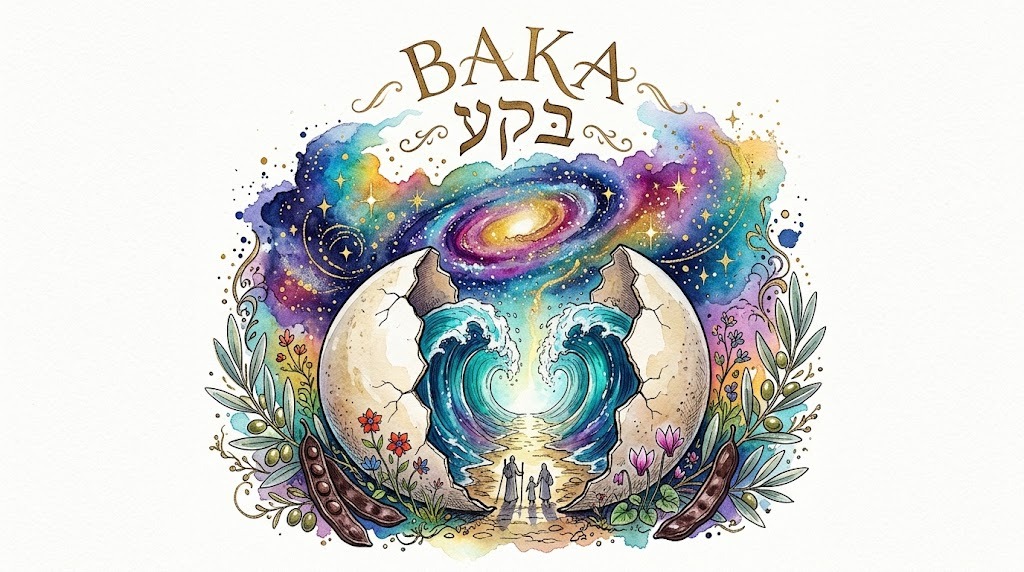
The Hebrew for splitting the sea is בָּקַע. It is also the word for a chick breaking out of its shell. Redemption and hatching are one verb.
That is not modern Hebrew borrowing a convenient image. The hatch reading stands in the prophet outright: וּבֵיצֵי צִפְעוֹנִי בִּקֵּעוּ, they hatched the eggs of vipers (Yeshayahu 59:5).
One verb, four depths
The flood does not begin with rain. It begins with a splitting, and the clause puts the deep and the verb in a single breath.
נִבְקְעוּ כָּל מַעְיְנֹת תְּהוֹם רַבָּה
All the fountains of the great deep were split open. Bereishit 7:11
Centuries later the sea ends the way the flood began.
וַיִּבָּקְעוּ הַמָּיִם
And the waters were split. Shemot 14:21
The same root breaks open the morning.
אָז יִבָּקַע כַּשַּׁחַר אוֹרֶךָ
Then your light will break forth like the dawn. Yeshayahu 58:8
It also names the ground where the dead stand up. When Yechezkel is set down among the dry bones, the place he is put in is הַבִּקְעָה, the cracked-open valley (Yechezkel 37:1).
One verb opens the floor of the world, opens the floor of the sea, opens the first line of morning, and opens the grave. Four performances of one act at four depths.
A shell cracking on a kitchen table is the fifth, and it is the only one of them a person is permitted to perform themselves.
A membrane that holds, and then gives
The second day of creation installs a wall made of nothing.
יְהִי רָקִיעַ בְּתוֹךְ הַמַּיִם, וִיהִי מַבְדִּיל בֵּין מַיִם לָמָיִם
Let there be a firmament within the waters, and let it separate between water and water. Bereishit 1:6
A boundary that separates and holds while something grows on one side of it is a description of a womb, and the spirit above it is מְרַחֶפֶת, brooding, which the Gemara reads as a dove hovering over her young without touching them (Chagigah 15a).
The same letters that split carry a twin, divided only by their vowels. שֶׁבֶר is a breaking, and מַשְׁבֵּר is the stool a woman braces on when the breaking comes.
כִּי בָאוּ בָנִים עַד מַשְׁבֵּר, וְכֹחַ אַיִן לְלֵדָה
The children have come to the birthstool, and there is no strength to deliver. Melachim II 19:3
A nation crowning and unable to be born. Baka, mashber, yibaka: one gesture. A membrane gives, and light that was being held comes through.
Why the sea ran
The verse describes the sea fleeing.
הַיָּם רָאָה וַיָּנֹס
The sea saw and fled. Tehillim 114:3
The Midrash asks what it saw, and answers with a man running out of a room.
בִּזְכוּת וַיַּעֲזֹב בִּגְדוֹ בְּיָדָהּ וַיָּנָס
In the merit of: he left his garment in her hand and fled. Bereishit Rabbah 87:8
Yosef ran out of Potifar’s house with his coat still in a woman’s hand, and generations later the water ran for his descendants using that same verb. The man who fled, the prophets who ran to Chorev, and the sea that fled are one motion. The deep makes way for whoever has already run.
The heel that cracks the shell
The one who breaks through is named for the act. Yaakov is born gripping the עָקֵב, the heel (Bereishit 25:26), the one who comes out last and emerges holding on, breaking into the world at the very back of his brother.
Read the three letters of splitting in the other direction and ב־ק־ע becomes ע־ק־ב. The shell that breaks and the heel that emerges are one root read both ways.
Read them forward into a name and you get עֲקִיבָא. Akiva began learning Torah at forty. He looked at a stone hollowed out by dripping water and said that if soft water can carve hard stone, the words of Torah can carve his heart (Avot d’Rabbi Natan 6).
Akiva is the heel become a teacher: the one who breaks the hardest shell by patient dripping. Water splitting stone, a chick splitting an egg, a sea splitting for Israel, one method at three scales.
The Name that is also the number
No two eggshells are geometrically identical, and π governs the curvature of every one of them, so the light leaving each shell is mathematically unique. No act of lighting one is a repeat of another.
שַׁדַּי, which the Sages read as שֶׁאָמַר דַּי, the One who said enough, carries the value 314. Shin is 300, dalet is 4, yod is 10.
Three, one, four. The Name of the boundary is the number of the boundary: the ratio that closes every circle and that no finite string of digits ever exhausts. The One who said enough to creation is written into the one constant that bounds a shape and never finishes.
That Name is also the one Israel wears rather than pronounces. The shin stands on the housing, the dalet is the knot at the back of the head, the yod is the knot at the hand: שדי spelled across the boxes and never said aloud. The Gemara holds that God binds the same boxes on Himself (Berachot 6a). The One who set the limit wears it.
Life is balanced on the edge of an eggshell (Kiddushin 40b), and a flame inside a single shell can tip the scale of a lifetime.
Which is what the title means
יַם סוּף is written with the same letters as סוֹף, an end. Israel does not only cross water.
The sea of the finite opens, by the verb that opens graves and dawns and wombs, and a people walks through the middle of ending on dry ground.
Kol Tehom, subtitled How Israel Splits the Yam Suf, is free to read in English and in Hebrew. The practice is here.
Keep reading
- Under His Wings Avraham leaves one bird uncut, and the world was hatched rather than built
- Solomon’s Question, Answered by an Eggshell how a finite vessel holds what the heavens cannot
- Tehom the deep, and the four letters that also spell essence
The map shows how all of it connects.
Why would a soul go through all this? A thousand doses.
Read: A Thousand Doses of Death
New teachings by email, and a bottle to pick up from us in Petah Tikva. The light of Sinai for your table.