At the Table: Why We Light
Why anyone lights
A Jew is named for thanks. Leah named her fourth son out of the one sentence she said when she stopped counting what she was owed.
הַפַּעַם אוֹדֶה אֶת ה׳ עַל כֵּן קָרְאָה שְׁמוֹ יְהוּדָה
This time I will thank Hashem; therefore she called his name Yehuda. Bereishit 29:35
The Gemara reads that as a first in the history of the world.
מִיּוֹם שֶׁבָּרָא הַקָּדוֹשׁ בָּרוּךְ הוּא אֶת עוֹלָמוֹ לֹא הָיָה אָדָם שֶׁהוֹדָה לְהַקָּדוֹשׁ בָּרוּךְ הוּא, עַד שֶׁבָּאתָה לֵאָה וְהוֹדַתּוּ
From the day the Holy One created His world, nobody thanked Him until Leah came and thanked Him. Berachot 7b
Yehudi is a job description. Everyone carrying the name is carrying the word for a person who gives thanks, and most of us have forgotten that this is what the name says.
Thanks that stops with you is unfinished
Gratitude kept inside one person dies with that person. A flame is the one thing in the house that can be given away without being lost: light a second wick from the first and the first does not shrink. That is the whole argument for the practice on this page. The oil is the thanks, the wick is the person, and the only question worth asking at the table is who gets it next.
Avraham is the first one called Ivri, the one from the other side, and the Midrash reads the name as a standing position rather than a border crossing: the whole world on one side and he on the other (Bereishit Rabbah 42:8). Crossing stays in the family. His grandchildren cross a river, cross a sea, and the festival that carries the escape out is named for a passing over.
וְהִגַּדְתָּ לְבִנְךָ בַּיּוֹם הַהוּא
And you shall tell your son on that day. Shemot 13:8
The night God passes over the houses is built as a handover, with the obligation to say it out loud to someone younger sitting inside the law itself. Pesach is a passing over in both directions: His over us, ours to the next one at the table.
Teshuva is that same motion worn down to its root. Return. I hold that a soul comes back for the same reason a candle is lit from another candle, to close a circle somebody left open, and that the circle closes when what was received gets handed on. Nobody finishes alone and nobody finishes in one lifetime.
Light it for that. The halacha below is the ordinary halacha of Friday evening, and the drops are the intention.
Nothing here replaces anything, and no new law is involved. The lighting follows the halacha of every Friday, at its time, by whoever lights in the house. What is added is a few drops and an intention. The arrangement below is symbolic, offered as an eggsample, not as a received custom.
The permission comes first
If the practice were forbidden, none of the rest would matter. It is not.
כָּל הַשְּׁמָנִים כּוּלָּן יָפִין לַנֵּר, וְשֶׁמֶן זַיִת מִן הַמּוּבְחָר
All the oils are fit for the lamp, and olive oil is the choicest. Shabbat 23a
Olive is the preferred fulfilment and not the only one, and the Rambam codifies that any oil giving a steady flame is valid (Hilchot Shabbat 5:9-11). The eggshell lamp is itself mentioned in Mishnah Shabbat 2:1-2 as an ordinary thing, and the Gemara argues its parameters, including whether the shell may be carried on Shabbat (Shabbat 43b-44a), without one word of objection. It was common enough to generate edge cases.
No classical authority forbids adding oils to a lamp that is already permitted. The question was never closed. It simply stopped being asked.
The vessel
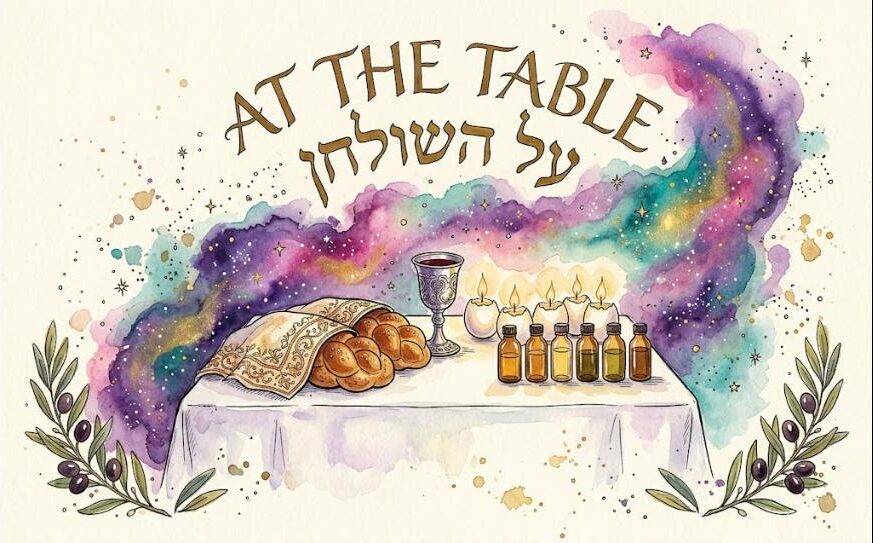
The shell comes out of the bin. Rinse a broken half, let it dry, and it holds a spoon of oil and a short wick. Olive is the base. The fragrant oil goes in beside it, by drops. A plate underneath is enough.
For the fuller arrangement: float the shell on water in a clay cup, over a few small stones no tool has touched, the kind David took from the stream.
חֲמִשָּׁה חַלֻּקֵי אֲבָנִים מִן הַנַּחַל
Five smooth stones from the brook. Shmuel I 17:40
The son of Nun stood twelve stones inside a river (Yehoshua 4:9). Stones no iron has shaped, standing in water, under a fire.
Before the match
Crown first. Malkeinu before Avinu, our King before our Father, which is the order the anointing oil itself kept: the Mishkan, then its vessels, then the kohanim, then the kings of Israel, in that sequence (Shemot 30:22-33). God is crowned before any human being is, and before anything is asked for.
Next, name the souls the flame is for. The ones you knew, and the ones nobody at any table remembers.
Different oils, different work
Oil has never had one job. Samuel took the horn of oil and anointed David among his brothers (Shmuel I 16:13). Pure beaten olive oil fed the lamp in the Mishkan (Shemot 27:20). Yeshayahu describes wounds left untreated, “not softened with oil” (Yeshayahu 1:6), because oil was medicine too. Today one oil carries a car across the country and another keeps its engine turning.
וּנְתַתִּיךָ לְאוֹר גּוֹיִם
I will make you a light to the nations.
Yeshayahu 49:6
A light to the nations begins with noticing what we burn. How we fuel a flame is how we fuel a body: different things do different things. Choose the oil for the lamp the way you would choose what to eat, by what you need it to do.
One eggsample: seven symbolic oils
The seven below are a symbolic eggsample, one way to read a table through oil, and nothing more binding than that. Any oil from the collection can take a place. Pick by what the flame is for.
Mushroom
For the dead the dew raises, and for seeding ground you will never see.
A mushroom comes up overnight out of a dead stump, and the halacha refused to call it fruit of the earth: it grows from the earth but does not draw from the earth (Berachot 40b). The parallel sugya says what it feeds on instead, מֵאַוֵּירָא, from the air (Nedarim 55b). אַוִּיר is אוֹר with a yod driven into its centre, so what it draws on is light with the seed still buried in it. The whole argument is here.
It does not spread by seed either. It casts billions of spores into the dark toward soil it will never stand in.
Carob
The fruit of the mountain the runners came to.
Sinai’s second name is Chorev, and those three letters read from the far end give בָּרַח, he ran. Moshe arrived there running from Pharaoh and Eliyahu arrived there running from Izevel, four centuries apart. Spell the mountain full and חוֹרֵב carries the same four letters as חָרוּב, the carob. The Midrash makes needing that fruit the thing that turns a person around: when Israel needs the carob, they return (Vayikra Rabbah 35:6). More here.
Pear
The enemy’s name sweetened into light.
The pear is אַגָּס, one letter from אֲגָג, king of Amalek, and in English it says eggs. A drop of it in the shell is eggs inside the egg. The Gemara records that descendants of Haman, out of Agag’s own line, learned Torah in Bnei Brak (Gittin 57b), which is the whole principle in one fact: the enemy is a vessel that has not yet been turned. It is a Purim move, וְנַהֲפוֹךְ הוּא (Esther 9:1). Laughing your way into a piece of wisdom is permitted.
Onion
The shadow-substance Betzalel worked.
The onion is בְּצָל, and בְּצַלְאֵל means in the shadow of God. Look at where the deep places are named, מְצוּלוֹת, and צֵל, shadow, is sitting inside the word: the depths contain shadow and the shadow contains the depths. Where Yosef descends into the deep and brings up the essence, Betzalel descends into the shadow and builds the vessel that holds it. Two men, one void, two trades.
ה’ שֹׁמְרֶךָ, ה’ צִלְּךָ עַל יַד יְמִינֶךָ
God is your guardian; God is your shadow at your right hand. Tehillim 121:5
Betzalel stands in God’s shadow, and the psalm makes God the shadow at a man’s right hand. A shadow follows the movement that casts it, so the hand that pours the oil makes the motion and the shadow answers it. Returning the onion’s oil to a flame returns the raw material of the shadow to the work it was built for.
Almond
The tree of the bone death cannot touch.
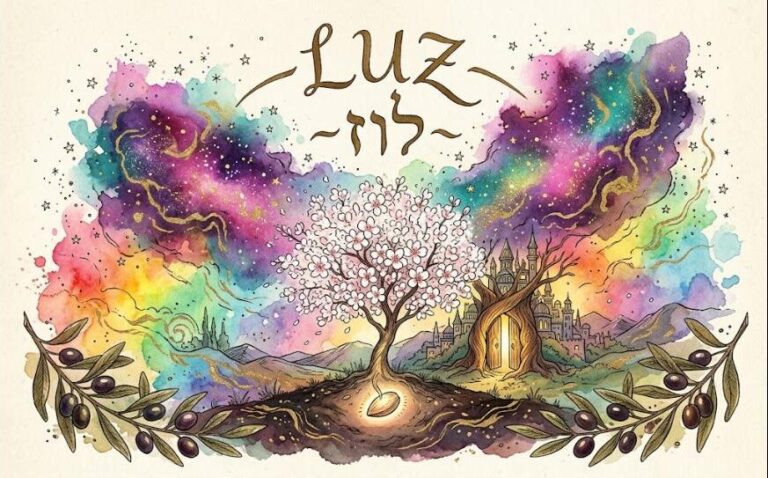
לוּז names two places where death is said to have no jurisdiction: the bone at the top of the spine from which a body is rebuilt, and a city reached through a cave behind an almond tree where the Angel of Death has no permission (Sotah 46b). It is also the wood of the staff that budded and bore almonds overnight to settle who the kohen was (Bamidbar 17:23), which is the same Aharon who stood between the dead and the living holding a fire-pan. More here.
Pumpkin seed
The door of knowledge, for Marcheshvan, sweet where the month is called bitter.
דְּלַעַת is a דֶּלֶת, a door, with an ayin standing inside it, and it is also דַּעַת, knowledge, with a lamed driven into the middle. A door with an eye in it, and knowledge with learning pushed through the centre.
The Gemara pulled an eye out of the same word first, in the chapter on dreams:
אֵין מַרְאִין דִּלּוּעִין אֶלָּא לְמִי שֶׁהוּא יְרֵא שָׁמַיִם בְּכָל כֹּחוֹ
Gourds are shown only to one who fears Heaven with all his strength. Berachot 56b
דִּלּוּעִין is unpacked there as דָּלוּ עֵינַי לַמָּרוֹם, my eyes are lifted on high, which is Chizkiyahu praying on what he had been told was his deathbed (Yeshayahu 38:14). The man who said it got fifteen years added to his life. A door, an eye, knowledge, and a sentence spoken by someone sent back.
Pressed from the harvest of the eighth month. The flood began on the seventeenth of that month, the deep splitting from below before any rain fell, and every year the rain prayer is inserted on that date into the blessing that revives the dead. More here.
Spikenard
For the king at his table.
עַד שֶׁהַמֶּלֶךְ בִּמְסִבּוֹ, נִרְדִּי נָתַן רֵיחוֹ
While the king was at his table, my nard gave its scent. Shir HaShirim 1:12
The same letters sit inside נִרְדָּם, asleep. A scent for the lamp held quiet, and for the one it is lit for who cannot answer.
This is not divination, and the difference matters
The Talmud warns against consulting שָׂרֵי שֶׁמֶן and שָׂרֵי בֵיצִים, the princes of oil and the princes of eggs: practitioners who peered into oil and eggshell to reach lower forces (Sanhedrin 101a). The warning is real and it should be said out loud on a page like this one.
The direction here is the reverse. Nobody is peering into the oil to ask it anything, and nothing is being consulted. Solomon did not consult the shedim; he put them to work building (Gittin 68a). Filling a shell with oil and lighting it for Shabbat with intention puts the shadow to work building a sanctuary inside a house.
Through the year
Change the oil with the season, the way a soul changes. A few drops and an intention, every week, until the oil fills every vessel.
Everything is made in small batches in Israel and shipped from Petah Tikva. The full collection runs to over a hundred oils, each labelled with its source. 26 oilz carries twenty-six, for the twenty-six of the Name. Carob oil stands on its own, and the gift set includes the egg-shaped diffuser.
The reasoning behind every one of them is worked out in Kol Tehom, free to read in English and in Hebrew.
Keep reading
- All the Oils Are Beautiful for the Lamp the permission, and the sage who tried to close it
- Solomon’s Question, Answered by an Eggshell why the fragile vessel is the preferred one
- Why a Candle Is Lit for the Dead a wick keeps praying after the mouth has closed
- Where Is the Soul of the Carob? seed oil or macerated pod, and why both answers hold
The map shows how all of it connects.

New teachings by email, and a bottle to pick up from us in Petah Tikva. The light of Sinai for your table.